It’s chusan (初三), the third day into the Year of the Horse, and even Honghe Prefecture’s less popular areas are dealing with a heavy flow of holiday traffic. Having driven two hours from Mengzi, the grayish-blue hue of Yilong Lake (异龙湖) finally stretches out across the distance, indicating I’ve made it to the mysterious land of tofu and train tracks— Shiping County (石屏). Winter in southern Yunnan is hovering around a comfortable 22 degrees Celsius, as the bright, moss green fields of farmland and locals picking out fresh vegetables, present a vibrant landscape. Yet, hidden under the green rolling hills, are the hefty steel tracks of the Gebishi Railway, appearing in spurts, but guiding us along to the next stop.
Home to some Yunnan’s most recognizable tofu, Shiping tofu gains its recognition from the mixture of the area’s low-mineral mountain water and soybeans, that coagulates slowly, giving it an elastic, but tender texture. Skilled craftsman have passed on the techniques of their tofu production methods from one generation to the next. While Shiping is often associated with its tofu origins, it is also the base of the western section of the narrow-gauge Gebishi railway. Weaving together the towns of Shiping, the tin capital of Gejiu, and Mengzi’s Bisezhai train station, the connecting point to the Yunnan-Vietnam Railway, Shiping’s influence in railway culture and local politics also runs deep.
“Have you been to the ancient town of Shiping or Wenmiao Jianzhuqun Temple?” a family friend asks me as I finish a bowl of soup filled delicate tofu skin and thinly sliced vegetables. “I have, but they’re too crowded during Chinese New Year. What’s around in Baoxiu? I heard the last train station along the Gebishi Railway is over there,” I ask as I finish up my lunch at a street-side restaurant not far from the Shiping’s historical center. “Oh it’s not far! You have to check out Baoxiu’s Yingcheng village. The old train station is nearby too,” the family friend says as he points west.
Zhengying Village: Former Battalion Turned Historical Site
Named after Baoshan Pavilion (宝山阁) and Xiushan Temple (秀山寺), Baoxiu Township has developed into a niche tourist spot within Shiping. Just ten clicks west of Shiping’s town center, Baoxiu sits tucked behind layers of narrow dirt roads and concrete paths. The peaceful breeze of the fields of swaying crops are often drowned out by the chugging sounds of small three-wheeled vehicles (三轮车) storming past. Walking past a farmer inspecting his potatoes, I park my car and together with family friends head towards the outskirts of Baoxiu, to the designated “National-level Historical and Cultural Village” — Zhengying (郑营).
Once a base for various military settlements, Baoxiu was garrisoned during the Ming Dynasty (1368-1644) by small battalions relocated to Yunnan to form a southern frontier defense. The battalions, often named after famous generals, gradually took on more permanent forms. Eventually twelve of them evolved into different villages, incorporating the Chinese character ying (营), meaning “camp”, into their village names. Though not one of the original battalions, Zhengying Village followed the same trajectory, taking its name after the general Zheng Taiwu (郑太武) and adopting the character 营 to reflect its military origins.
Today, the small village still carries traces of its storied past. Stone construction and design elements remain being especially prevalent among the many Republican-era (1912-1949) buildings. Though some have been designated as government-protected structures, many residents still live in these traditional spaces surrounded by limestone, maintaining a connection to the village’s past.
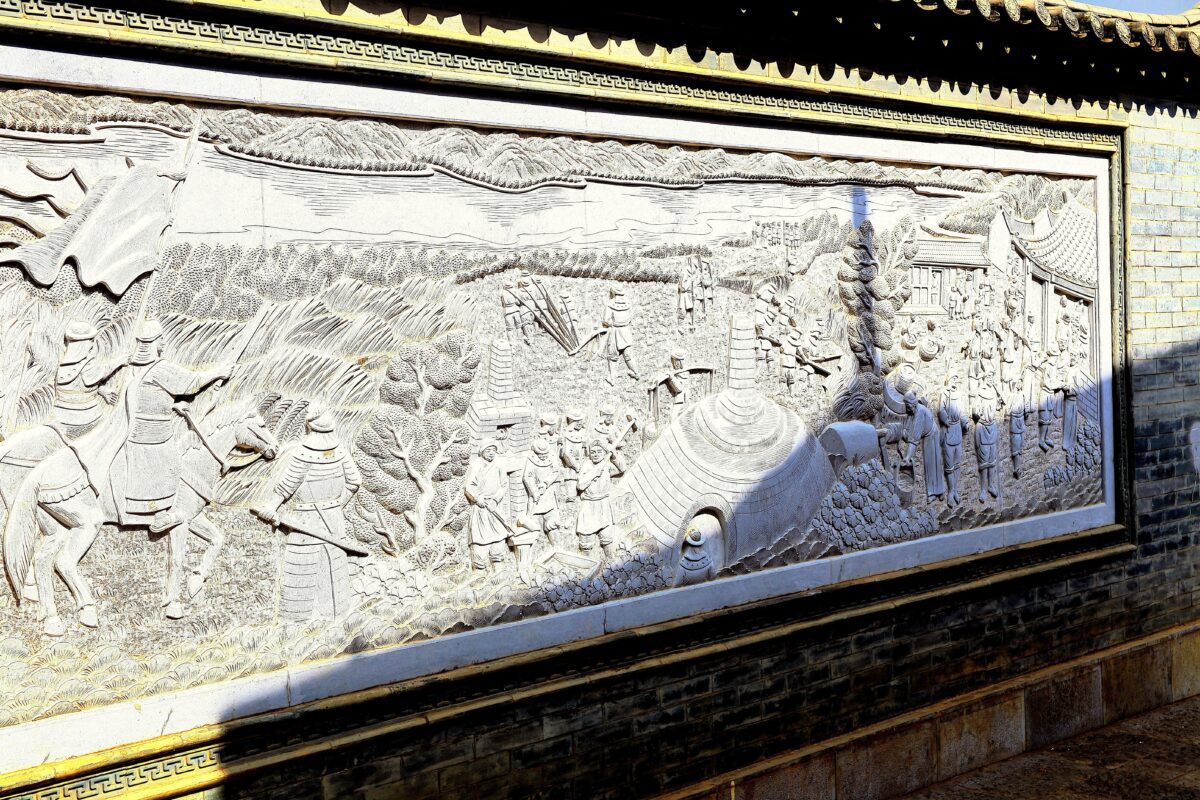
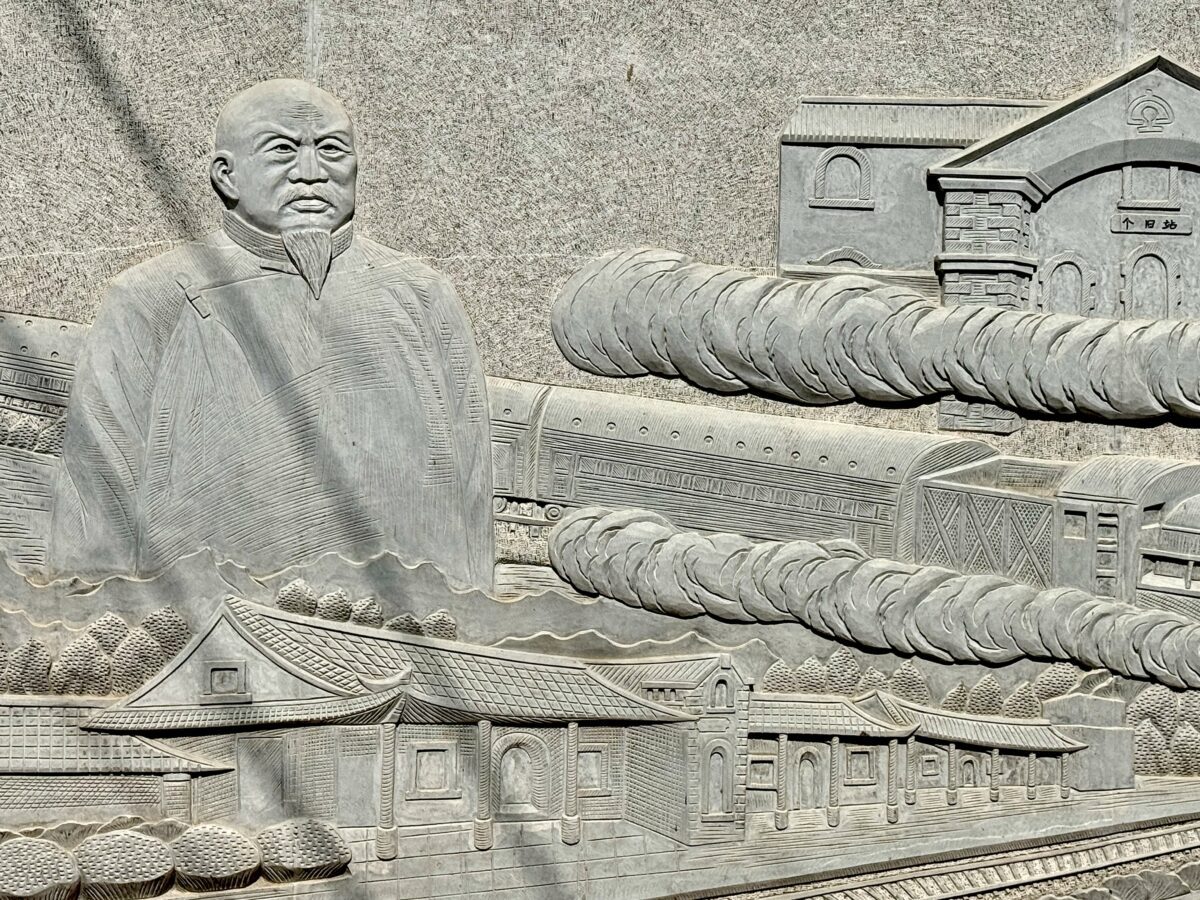
The stone and brick entrance, with a distinguishable sign embedded into the center section reads “郑营” in turquoise blue characters. Strolling in, multiple stone murals depicting the region’s history and a map of the different towns situated around Yilong Lake, capture tourists’ attention. A stone relief of Chen Heting, an influential businessman and politician from Baoxiu, with railways and train station engravings act as backdrops, pinpointing some of his major accomplishments.
Real growth began to occur in Baoxiu during the Qing dynasty (1644-1912) as Shiping’s economy developed and more people moved into the county. Positioned as a market center, Baoxiu’s trade focused primarily on soybean, tofu, grain, and rice. The area’s economy further evolved once it was integrated within Honghe Prefecture’s regional trade network, with the Gebishi Railway extending from Jianshui to Shiping, forming the western terminus.
Exploring Zhengying and Chen Heting’s Backyard
“Only people of a certain status could have these types of ancestral halls,” Mr. Li, a local Shiping native and Honghe history expert tells me as he points for me to follow him. My first stop is at Chen’s Ancestral Hall, a 1240 sq. meter complex built in 1925. A small three archway stone bridge with uniquely carved stone sculptures of the Chinese zodiacs and other spiritual creatures atop individual pedestals is a magnet for photographers.
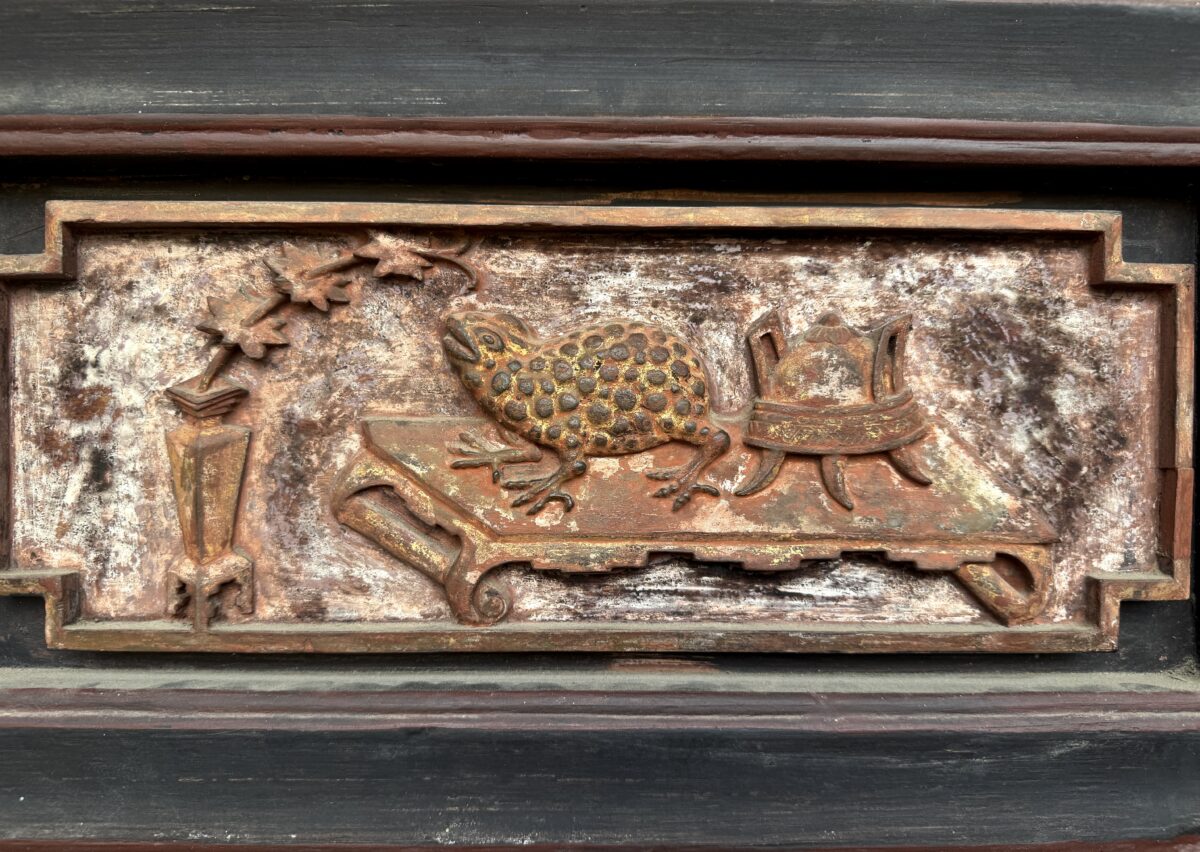
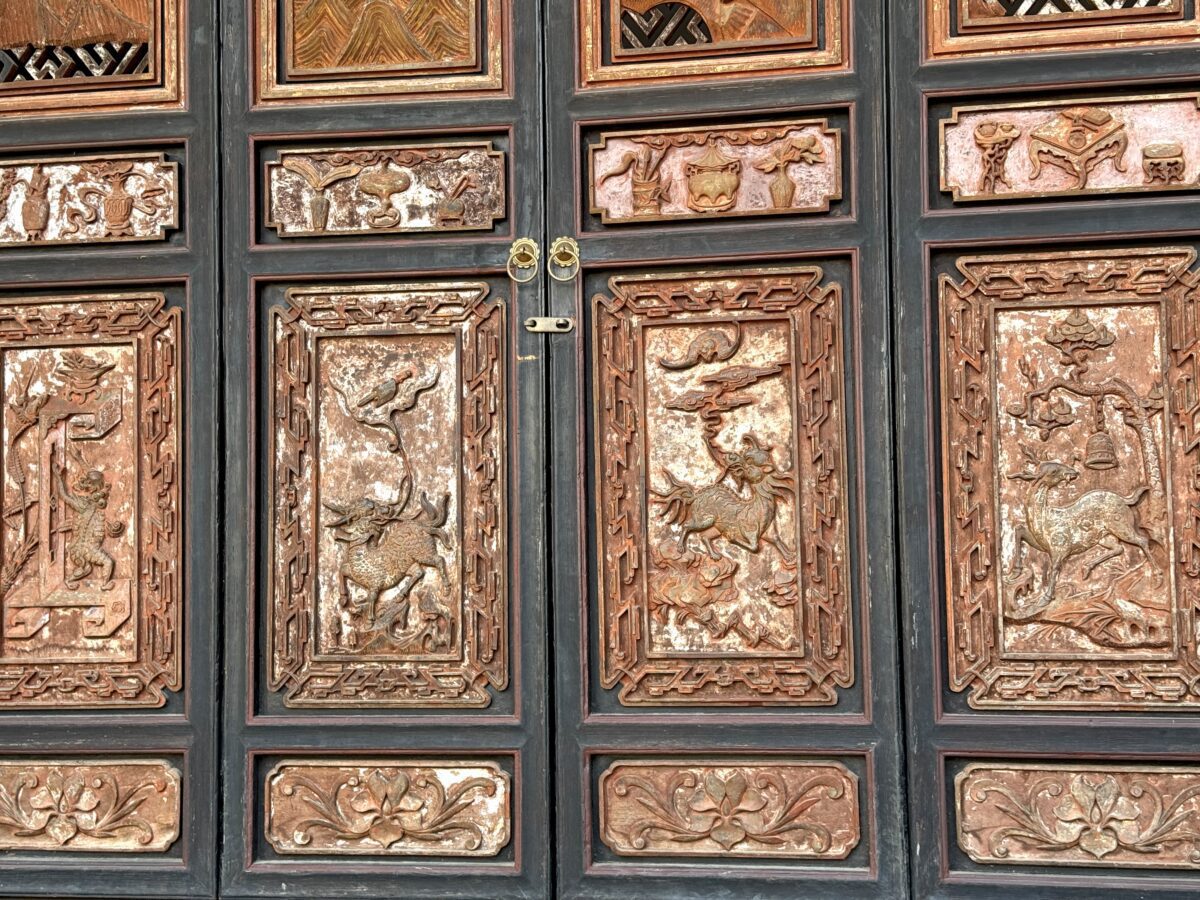
Venturing behind the first building, the first courtyard, is a wide open space surrounded by wooden living spaces on each side. Yet, it’s the set of six partitioned, red and black wooden doors (隔扇门) at the center front. Each pane, some with beautiful lattice work, others with deep-relief carvings, are intricately cut out. A closer look reveals each individual panel tells its own story. Some have a tint of gold glaze adding to its overall elegance, including a three-legged toad, which happens to catch my eye.
“What’s the story behind this picture?” I ask Mr. Li’s wife, a civil servant who works in Mengzi’. “This is a jinchan (金蟾). It’s a symbol for bringing in wealth.” Just as intrigued as I am about the depictions on the doors, Mr. Li brings the attention to a mysterious monkey on one of the larger panels.
“In ancient times there were five ranks of nobility. They were: Gong (公, a rank equivalent to Duke), Hou (候, Marquis), Bo (伯, Earl), Zi (子, Viscount), and Nan (男, Baron). This one here is a Hou. The monkey serves as a visual symbol of this rank, as the word for monkey hou (猴) is a homophone of Hou (候).” He shifts the attention to another panel with a mystical deer. “This is lu (鹿). Like in the idiom (鹿万金钟).” In Chinese, the pronunciation of the character 鹿 is similar to fenglu (俸禄), which refers to the salary or stipend of a government official.
Having racked my brains with the symbolism between different animals and their equivalents of nobility, we made our down to our next stop: The Chen’s Residence (陈氏民俗). Wooden beams, large open courtyards, and elaborate decorations deck the various walls, including wooden cutout panels displaying various flowers. Encompassing three separate sections, we walk down to the back section. “Before they used to ride a boat from Baoxiu train station all the way down to Zhengying village. There’s no more river now,” Mr. Li says shaking the back gate to examine its sturdiness. Hoping to avoid the dinner traffic back to Shiping, we hop into our car and head off in search of the last train station.
Baoxiu Train Station: Last Stop Along the Gebishi Railway
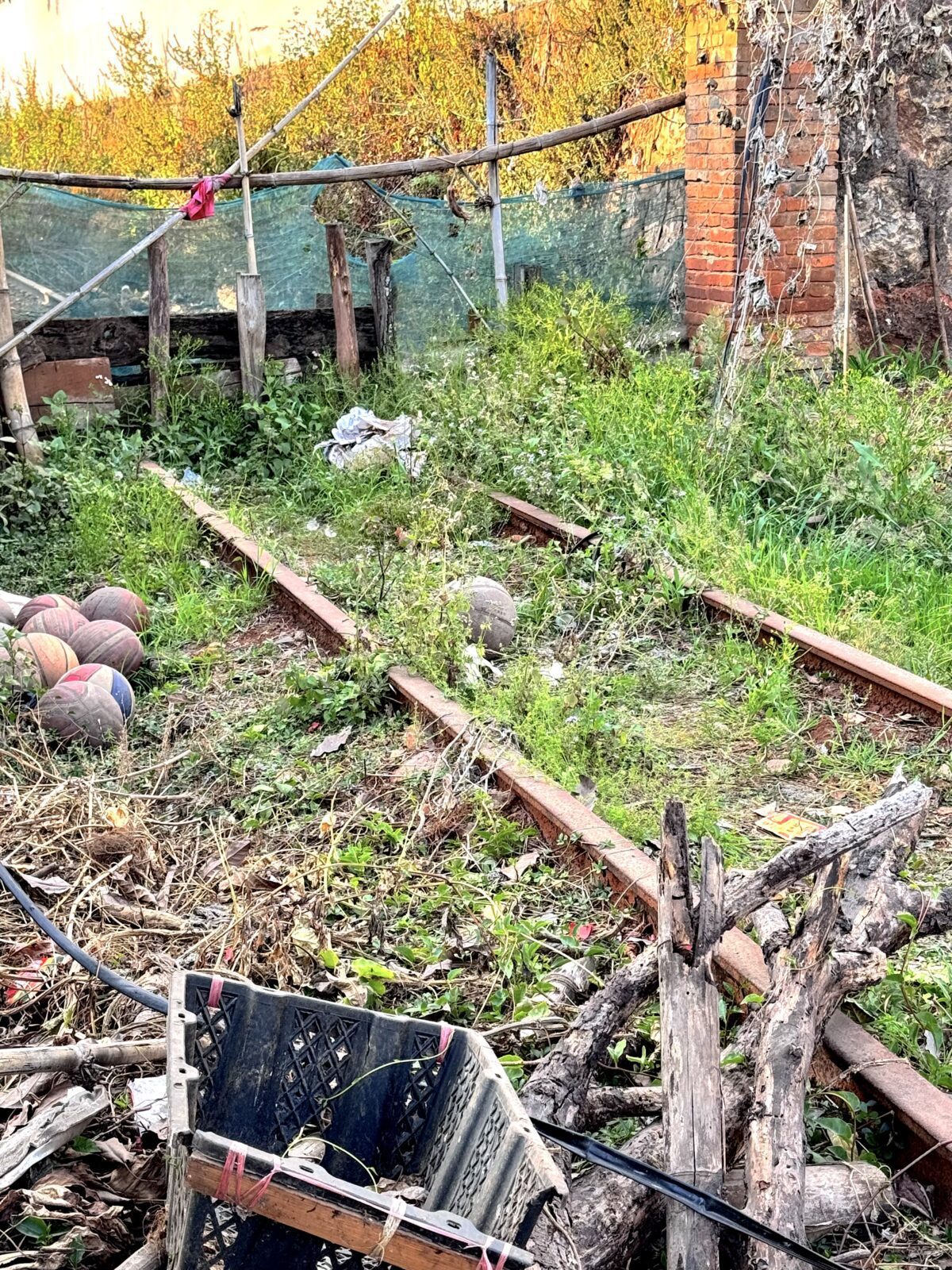
Following the directions of locals, we finally arrived in the vicinity of the final station. Dusty roads, smatterings of haphazardly built dwellings, and stockpiles of supplies on road sides. The sight shocked me. The steel rails going west, which I had anxiously followed, vanished off into the middle of a chicken pen, disappearing into the dirt mound beneath their thin, scrawny feet. I assumed there would’ve been a more elaborate historical marker or respectable structure to signal the end of the end of the large scale project. Instead, a couple farmers tending to their crops alongside the tracks took a glance up to look at me, double checking if their hens were still around.
Left a tad dispirited at the site’s current situation, I continued following the tracks east towards Baoxiu station. A five minute walk later, and a couple stacks of large railroad ties appear, as well as a brick building. Mr. Li’s wife was up ahead chatting with the locals. “This is the old supply station. It’s not used anymore. Baoxiu Station is next to the lookout shelter,” she says. Up ahead lay the remains of the last train stop along the Gebishi Railway.
According to the Yunnan-Vietnam Railway Research Institute based in Kunming, Baoxiu wasn’t supposed to be the last stop. In 1960, the Ministry of Railways had dismantled more than 10 km of railway tracks from Mengzi train station to Bisezhai (碧色寨). Initial plans were to reinstall the tracks along the already established Gebishi railway, starting from the Shiping station. From Shiping, the route would be extended further west to a final destination called Longkouchong (龙口冲).
Earlier surveying had showed the presence of significant iron ore in the region—up to 100,000 tons. Extending the route would be extremely valuable for pursuing large-scale mining, allowing for the transportation of ore all the way to Gejiu. Upon further research, the iron ore in the region was not deemed as valuable as initially thought, resulting in the cancellation of railroad extension plans.
In 1964, the Gebishi Railway line was extended from Shiping to Baoxiu. Not originally part of the Gebishi Railway that was finished in 1936, many refer to this new section that connects from Baoxiu in the west to Mengzi in the east as the Mengbao Line (蒙宝线), a 143 km line of railway tracks. By 1971, the tracks underwent yet another round of changes, with the narrow-gauge track all swapped out for meter-gauge track. This allowed for a direct connection to the meter gauge track Yunnan-Vietnam Railway at Bisezhai. Slowly usage of the train tracks began to dwindle. By 2010, both passenger and cargo transportation along the Gebishi Railway had stopped.
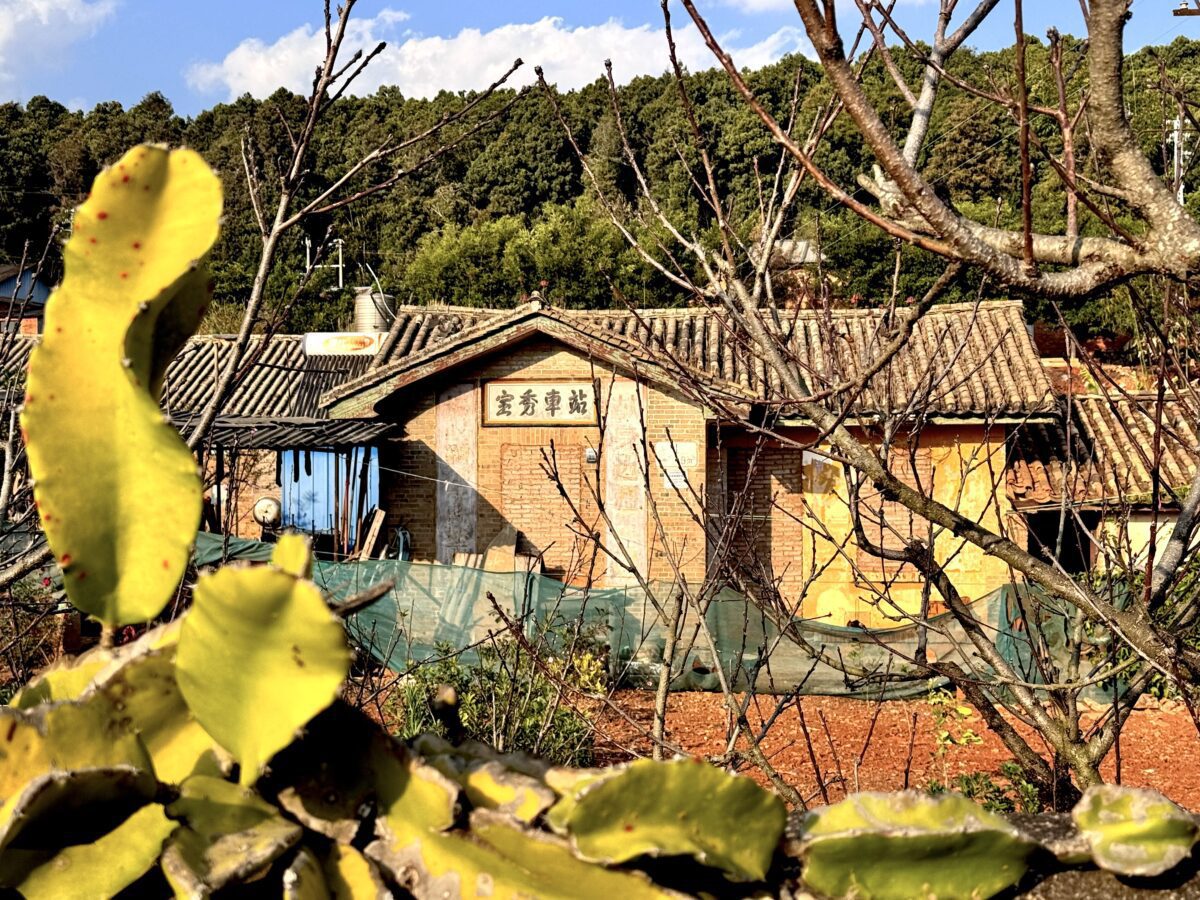
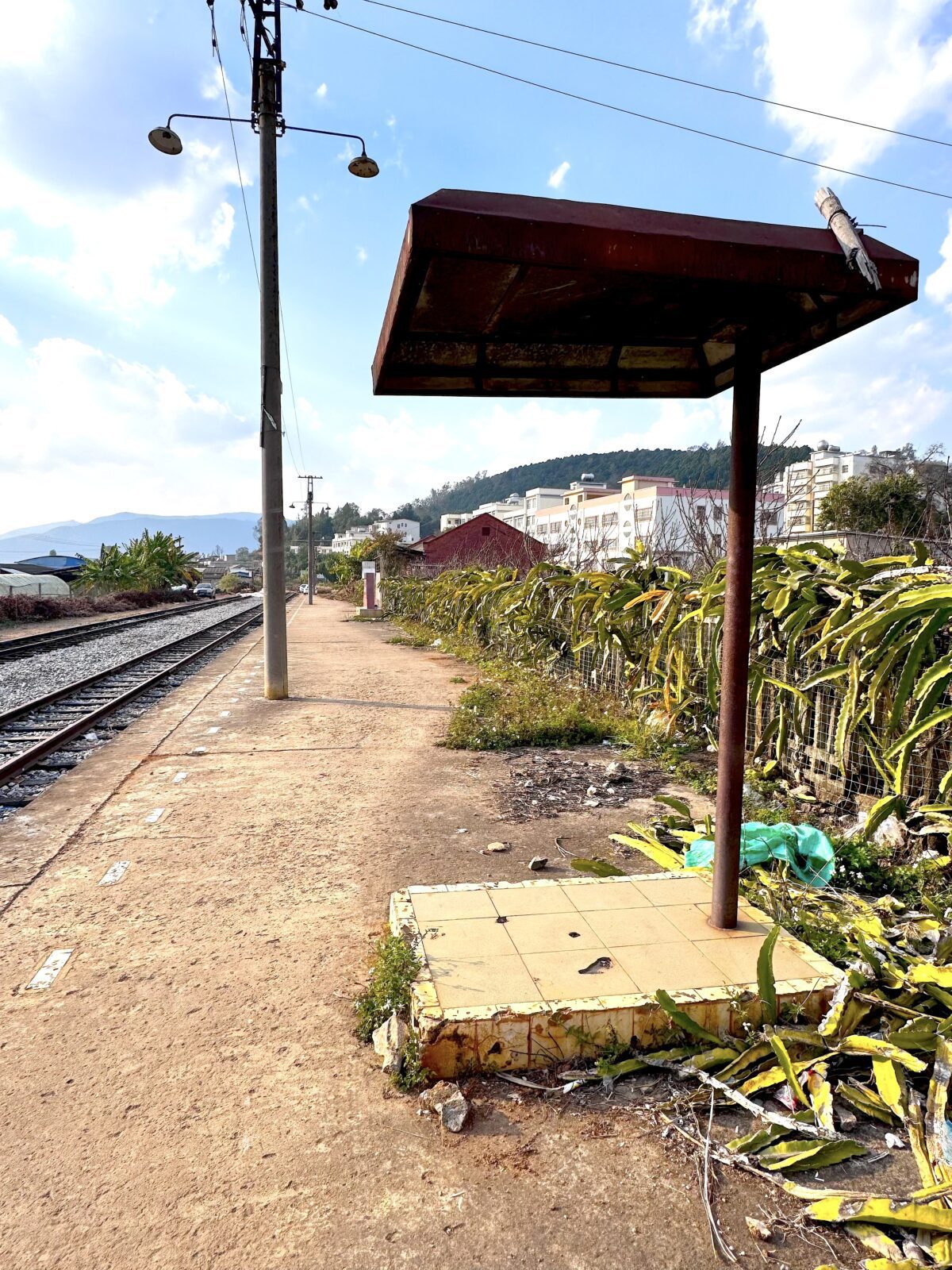
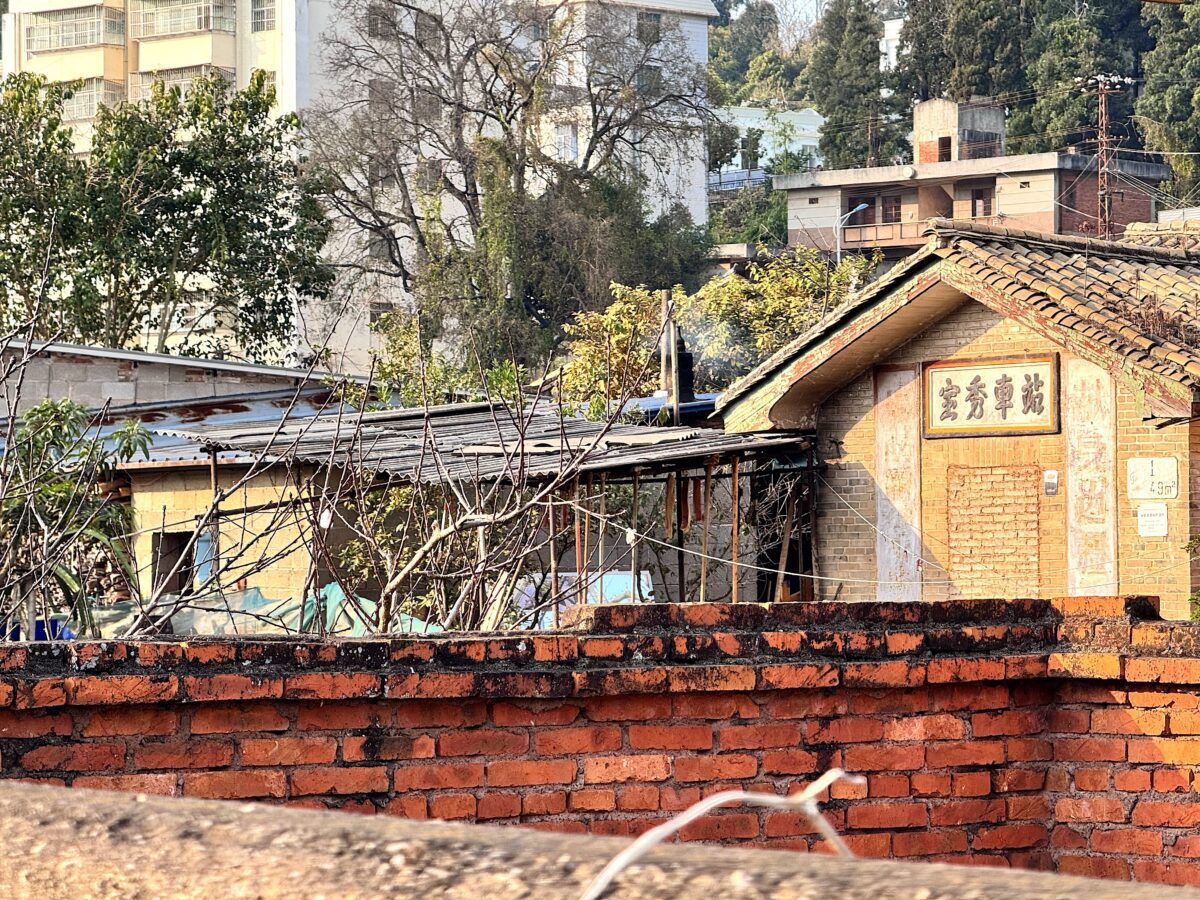
The orange-red Chinese characters “宝秀站” faintly appear from behind the entanglement of dragonfruit vines overtaking the deteriorating fence. It’s since become a personal dwelling of some locals. The front yard is overrun with various weeds, with some vegetables sprouting about. Snapping a few shots, I walk over to a small platform covered by fading, overhead canopy next to the tracks.
Each station along the Yunnan-Vietnam Railway has its own story to tell. Yet, Baoxiu Train Station, slowly fading behind the allure and tourist pull of old villages such as Zhengying, seems like its real story may never find itself under the spotlight.